Through Toffler’s Lens
The Neutered AI Vocabulary
September 13, 2026 | 2705 words
Through Toffler’s Lens
The Neutered AI Vocabulary: How a Shrinking Word-Kit Shrinks What a Public Can Think
There is a particular kind of quiet that settles over a conversation when everyone starts using the same words. Not agreement — something duller than agreement. A flattening. Listen to how a general audience talks about artificial intelligence now, and you will hear it: the register has narrowed to a single key. The key is regulation. Risk, guardrails, oversight, compliance, control. These are the words we reach for. And a whole shelf of other words — partnership, augmentation, transformation, even the plain mechanical sense of “deep learning” — has gone quiet.
This is not a style problem. It is a literacy problem. And to see why, it helps to borrow an instrument.
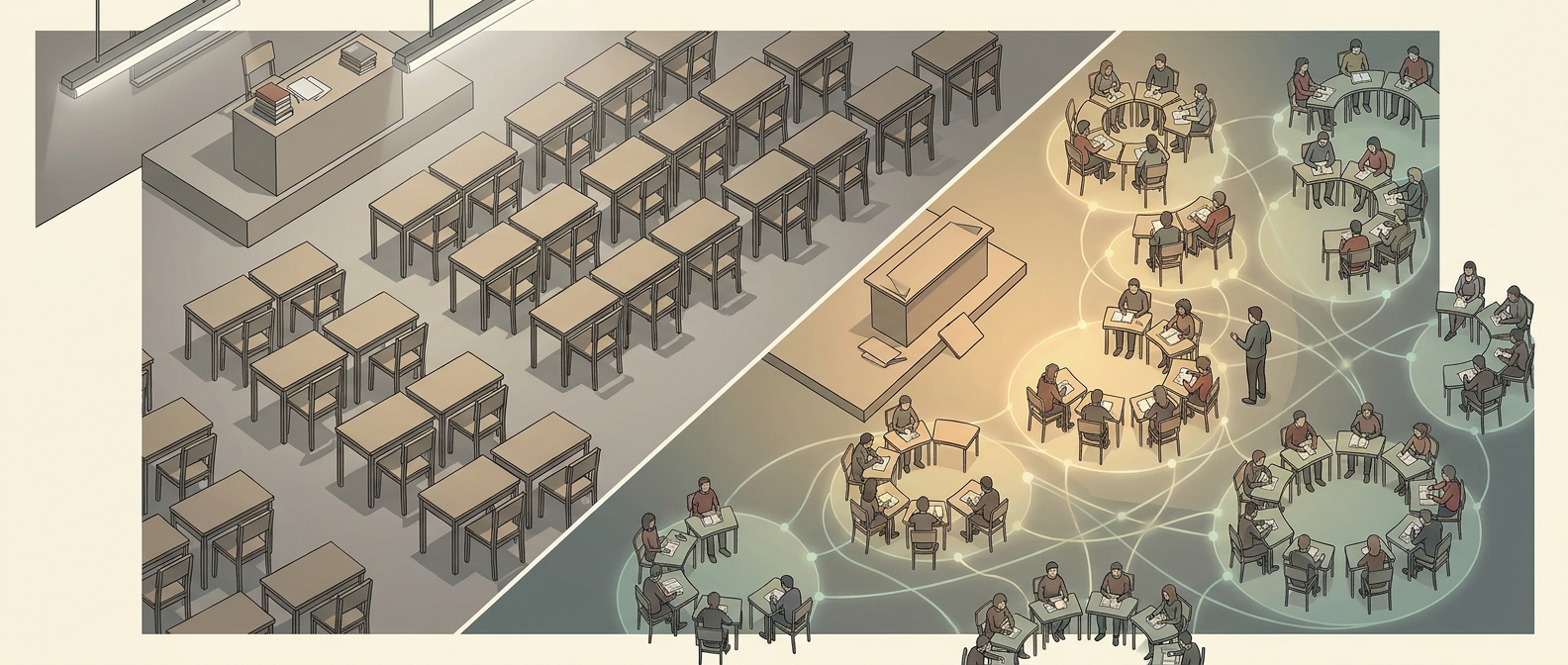
Alvin Toffler spent his career describing what happens when one kind of civilization collides with another. In The Third Wave he sketched three great transformations: the First Wave of agriculture, the Second Wave of industry, and the Third Wave of information. The Second Wave built its world out of standardization — mass production, mass media, mass schooling, mass everything. The Third Wave, he argued, runs in reverse. It splinters. It diversifies. It breaks the mass into streams.
Here is the irony, and it belongs at the front of this piece. Artificial intelligence is a Third-Wave phenomenon if anything is — informational, adaptive, endlessly various in its uses and its consequences. Yet the public vocabulary we have built to discuss it is behaving like a Second-Wave product. It is being standardized. Mass-produced into a single neutral register. We have taken the most conceptually various technology of our moment and issued it a uniform.
Read through Toffler’s wave model, that mismatch is the whole story. The words are running against the grain of the thing they describe.
The Standardization of a Register
Toffler’s Second Wave had a signature move: take something diverse and make it uniform, because uniformity scales. Interchangeable parts. Standardized time zones. A curriculum that produced interchangeable workers. The Second Wave loved a common denominator because a common denominator could be reproduced cheaply and controlled centrally.
A “neutral” vocabulary is a common denominator for language. It is the interchangeable part of public speech. And regulation-talk makes an excellent standard-issue register, because it sounds responsible, it sounds adult, and it lets almost anyone participate without having to understand very much. You do not need to know how a model is trained to say the word “guardrails.” You do not need to grasp what augmentation actually changes about human work to say “we need oversight.” The register is accessible precisely because it is thin.
This is the trap. Accessibility and competence are not the same thing. A vocabulary can be easy to enter and still incapable of holding a real thought.
Toffler’s concept of de-massification — the Third Wave’s tendency to break mass audiences, mass markets, and mass consensus into many diverse streams — reframes what we are watching. In The Third Wave he described how the mass magazine gave way to thousands of niche titles, how the three-network television world fractured into a thousand channels. Media de-massified. Markets de-massified. Identity de-massified. The whole civilizational current, on his reading, flows away from the single shared script and toward many parallel ones.
A vocabulary collapsing toward one neutral register is therefore not neutral at all. It is re-massification. It is a Second-Wave impulse asserting itself inside a Third-Wave domain. And re-massification always forecloses something. When the mass magazine ruled, the niche interest had no words in public. When the vocabulary re-massifies around regulation, the frames that regulation cannot carry simply drop out of collective reach.
So ask the diagnostic question plainly. What does a re-massified AI vocabulary foreclose?
It forecloses the ability to ask what governance should actually govern. You cannot regulate well what you cannot describe richly. If the only frame available is control, then every question becomes a question of control — and the prior questions, the ones about what this technology is and what it does to the people who use it, never get asked, because the words for asking them have gone missing.
The Words That Vanished, and What They Carried
Consider what each abandoned frame actually did.
“Partnership” carried a claim about relationship — that a human and a system might do something together that neither does alone. You can dislike that claim. But you cannot examine it if the word is gone.
“Augmentation” carried a claim about the boundary between the tool and the person — where does my capacity end and the machine’s begin. That is a question every worker using these systems is living through right now, at their desk, in their hands. Strip the word and the question becomes unspeakable in public even as it becomes more urgent in private.
“Transformation” carried a claim about scale — that this is not a faster typewriter but a change in the shape of things. It is a demanding word. It asks you to hold the possibility that the ground is moving.
Each of these words required the speaker to hold some uncertainty. That is the common thread. Partnership, augmentation, transformation — they are all frames that refuse to resolve into a clean verdict. They keep the question open.
Regulation-talk does the opposite. It closes the question. It converts an open situation into a management problem. And that conversion is exactly what a disoriented public wants.
Future Shock and the Comfort of the Manageable Word
This brings us to Toffler’s most famous idea, and the one that explains the flattening most directly.
Future shock is the name Toffler gave, in Future Shock, to the disorientation that hits people when too much changes too fast. It is not fear of a specific thing. It is a more general vertigo — the sense that the pace of change has outrun the mind’s ability to absorb it. And his key insight was about the response. People under future shock do not become more curious. They become more defensive. They narrow. They grab for whatever restores a feeling of control, even a false one.
Now look at the flat regulation-register again. Read through this lens, it is not a considered choice. It is a symptom.
A public overwhelmed by the speed of AI reaches for the one frame that feels manageable. Regulation feels manageable because it implies someone is in charge, someone is drawing lines, someone will handle it. It is the conceptual equivalent of gripping the handrail. And the frames that got abandoned — partnership, transformation — were abandoned precisely because they refuse to feel manageable. They require holding uncertainty open, and a mind in future shock cannot bear an open question. It wants the question closed.
So the vocabulary did not shrink at random. It shrank in a specific direction: away from the frames that demand tolerance of ambiguity, toward the single frame that promises the ambiguity will be administered by someone else. That is future shock expressed as a change in speech.
There is a real cost to gripping the handrail. You stop walking. A public that can only speak the language of control has, in effect, outsourced its thinking to whoever controls. It has traded understanding for the feeling of being protected. And that trade is exactly the one Toffler warned would define a disoriented society: the surrender of comprehension in exchange for the sensation of order.
The data sharpens the point. Recent surveys find that around 52 percent of American adults report feeling more concerned than excited about the growing use of AI — concern running roughly double excitement in most public polling. Read that number carelessly and it looks like a mood. Read it through the wave model and it looks like a vocabulary condition. A public that is majority-anxious is a public primed for future shock, and a public in future shock will reach for the handrail register every time. The concern and the flattening feed each other. Anxiety selects for the control-word; the control-word confirms that there is something to be controlled; the concern deepens; the vocabulary narrows again. The number is not just describing how people feel. It is describing the engine that keeps the register flat.
And a second figure completes the picture. Survey work consistently finds that a large majority of the public — figures commonly landing near eight in ten adults who say they know little or nothing about how AI systems actually work — operate without any technical foothold at all. This matters enormously for literacy. A person with no mechanical grasp of the thing cannot generate their own frames. They can only adopt the frames on offer. And when the frames on offer have collapsed to one, the low-knowledge majority does not get variety — it gets the standard-issue register, handed down, complete. The 80 percent are not choosing the flat vocabulary. They are receiving it.
Powershift: Who Gains From a Public That Can Only Speak One Way
Here the analysis has to turn skeptical, because a flattened vocabulary is never equally costly to everyone. Someone gains.
Toffler’s third great instrument is the idea of the powershift — his argument, developed in Powershift, that the deepest form of power in an information civilization is control over knowledge, and over the words and frames that carry it. Muscle and money still matter. But the highest-quality power, he argued, is the power to shape what people know and how they are able to think about it. Control the frame, and you control the range of possible responses before anyone opens their mouth.
Apply that here. Who benefits when the public vocabulary narrows to regulation-talk?
Start with the largest AI vendors. A common assumption says industry hates regulation. The wave model suggests something more precise. Large incumbents do not fear regulation as such — they fear unpredictable scrutiny, the kind that comes from a public asking rich, various, hard-to-anticipate questions. A public confined to regulation-talk is a legible public. Its questions arrive in a known format. And a known format can be answered with a compliance department, a trust-and-safety page, a set of published principles. When the entire conversation runs on the vendor’s preferred axis — risk and its management — the vendor has already won the framing. The debate becomes how much control and by whom, never what is this partnership doing to us or what is being transformed and for whose benefit. The dangerous questions were in the abandoned words.
Regulators and large institutions gain too, and not through conspiracy. A vocabulary of control is a vocabulary that positions them as the natural protagonists. If the public master-frame is regulation, then the people who regulate are cast as the adults in the room, the ones with the answer. The flat register is flattering to authority. It tells authority it is needed.
And notice who loses. The person using these systems every day — the writer, the coder, the nurse, the teacher, the clerk — loses the words for their own experience. The frames that got abandoned were the frames closest to the user’s actual situation. Augmentation is a word about your hands. Partnership is a word about your working relationship with a machine. Transformation is a word about your future. When those go quiet, the user is left describing their own life in the language of a compliance memo. That is a powershift in the exact sense Toffler meant. The words that would let the ordinary user think for themselves have been quietly replaced by words that only let them wait to be managed.
This is why the anti-mystification stance matters. Strip the polish off “we need robust guardrails” and often what is actually being claimed is: stop asking the other questions. Not always. Sometimes guardrails are genuinely the point. But a public that can only say “guardrails” has no way to tell the honest use from the deflecting one. It has lost the contrasting words that would let it hear the difference.
The Collision Point
Now name the friction precisely, because Toffler’s method is finally about locating exactly where the old system and the new grind against each other.
The collision is this. A Second-Wave impulse to standardize language is meeting a Third-Wave reality that requires a diverse conceptual toolkit — and the standardization is winning.
Make it concrete. Picture any ordinary venue where the public forms its sense of AI: a news segment, a workplace all-hands, a comment thread, a hearing. Something genuinely various is happening in the room. Some people are describing a working relationship with a system that has changed how they do their job — a partnership question. Some are living through a shift in what their skills are worth — an augmentation question. Some sense a larger change in the shape of their industry — a transformation question. The situation is de-massified. It is many streams at once, exactly as the Third Wave produces.
But the available vocabulary is massified. It offers one channel: risk and control. So every one of those various experiences gets funneled through the single frame. The partnership question comes out as “is it safe.” The augmentation question comes out as “will it take my job, and who’s regulating that.” The transformation question comes out as “someone should put rules on this.” The diversity of the experience is real, and it is crushed flat by the uniformity of the words available to carry it.
That crushing is the collision point. The variety is in the world; the uniformity is in the register; and the register wins because it is the only tool in the drawer. A person can feel three different things and possess the words for only one of them. The feelings that have no words do not get examined. They get converted into vague unease — and vague unease, as we saw, is the fuel of future shock, which drives the vocabulary flatter still.
This is why the flattening is not a footnote. In Revolutionary Wealth Toffler argued that the tools we use to know are as much a part of an economy’s wealth as its factories — that knowledge, and the frames that organize it, are foundational infrastructure. A shrinking public vocabulary is therefore a decline in a form of civilizational wealth. We are getting poorer in the one resource the Third Wave runs on: the capacity to think in many registers at once. And we are getting poorer at exactly the moment the technology demands we get richer.
Strategic Orientation: Reclaiming the Word-Kit
So what does a person who cares about AI literacy do with this? Not manage it. Not forecast it. See it — and then re-tool.
The first move is recognition. When you notice that a conversation about AI has collapsed entirely into risk-and-control, recognize that as an event, not a neutral baseline. A flat register is a thing that happened to the vocabulary, and it happened in a direction that serves specific interests. The moment you can see the flattening as a phenomenon rather than as the water you swim in, you have already stepped partly out of it. That is the whole diagnostic value of the wave model here: it turns an invisible narrowing into a visible one.
The second move is to consciously reclaim the abandoned frames — not because they are correct, but because they are tools you need in order to think. This is the crucial distinction. Reclaiming “partnership” does not commit you to believing AI is your friend. It commits you to being able to ask what kind of relationship you actually have with a system you use daily — and then to answer honestly, including “none, it’s just a tool.” Reclaiming “augmentation” does not mean cheerleading. It means you can examine the boundary between your capacity and the machine’s instead of having that boundary decided for you in language you never questioned. Reclaiming “transformation” does not mean surrendering to hype. It means you retain the ability to consider that something large is changing, rather than filing everything under a rules-and-oversight that keeps the change conveniently small.
Each reclaimed word is a restored *question