Through McLuhan’s Lens
The Expertise Inversion
May 17, 2026 | 2575 words
Through McLuhan’s Lens: The Expertise Inversion and the Unbuilding of the Literate Room
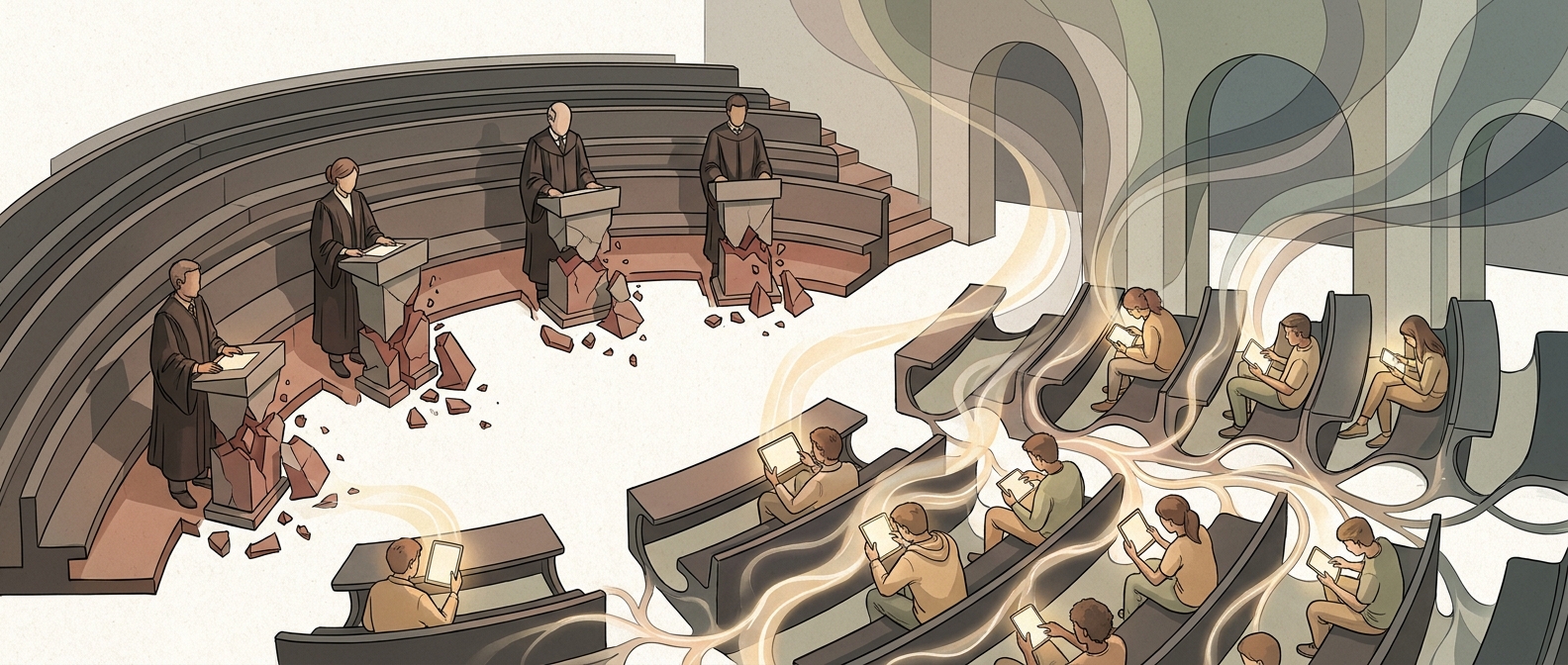
A composition instructor at a regional university in Ohio described the moment to a colleague this fall. She had spent twenty minutes walking her class through what she called “responsible prompting” — a careful, hedged demonstration of how to ask ChatGPT for feedback on a draft. A sophomore raised his hand. He did not challenge her. He simply offered, with the gentleness one uses on a relative learning to text, that the prompt she had written would return generic output. He suggested she give the model a role, paste in the rubric, ask it to disagree with itself once, and then ask it to revise. The class watched her try it. It worked. She thanked him. The lesson continued, but something in the room had shifted that the lesson plan did not name.
This scene, repeated in a thousand variations this semester, is what the discourse has begun calling the expertise inversion: the condition in which the credentialed teacher is no longer the most fluent user of the medium being taught. It is happening in classrooms. It is happening in law firms where second-year associates draft with Claude faster than partners can review. It is happening in newsrooms where interns route around senior editors. It is happening at kitchen tables where a fourteen-year-old shows a parent how to get past the model’s refusals. The inversion is the story of the season, and almost everything written about it so far has the wrong shape.
The wrong shape is this: the inversion is being framed as a gap. A skills gap, a fluency gap, a generational gap. Gaps can be closed. Closing them is a business — for the consultancies selling faculty workshops, for the platforms selling “AI literacy” certifications, for the publishers retooling their textbooks. The framing presumes that the old hierarchy is intact and merely needs to be re-staffed with retrained experts. Read through Marshall McLuhan’s Understanding Media, this framing is exactly the kind of misperception his work was built to dismantle. The inversion is not a staffing problem inside a stable structure. It is a sign that the medium under the structure has changed, and the structure has not yet noticed.
The Medium, Not the Output
McLuhan’s most quoted line is also his most misunderstood. “The medium is the message” does not mean that form matters more than content in some aesthete’s sense. It means that the effect of a medium on human relations is the actual content of that medium, regardless of what specific things the medium happens to transmit on a given day. Television’s “message” was not any particular show; it was a society reorganized around the living room. Print’s message was not any particular book; it was the private reader, the silent self, the linear argument, the footnote.
What, then, is generative AI’s message in the literacy environment?
It is not any particular essay a student submits or any particular lesson a teacher generates. The message is the redistribution of fluency by exposure-hours rather than by credential. A medium that learns from use, and that improves the user through use, distributes competence to whoever spends the most time inside it. This is a different distribution than the one literacy has run on for five centuries. Print rewarded those who could afford the slow accumulation: years of reading, the institutional gatekeeping of universities, the apprenticeship under a master. Generative AI rewards iteration density. The fourteen-year-old who has run ten thousand prompts since last winter has a kind of fluency that her teacher, who has run two hundred, structurally cannot match in a semester of in-service training.
The statistics from this week’s reporting make this concrete. A new survey from the Digital Education Council found that 86% of students report using AI in their studies, with 24% using it daily, while only 61% of faculty have used AI in teaching and a much smaller fraction use it daily. The asymmetry is not a matter of attitude or training budget. It is a matter of hours-in-the-medium. Students are inside the medium continuously. Faculty visit it.
McLuhan’s framework refuses the comforting interpretation that this is a temporary condition. The medium is the message means: this exposure-hour distribution is what the medium does. It is not a transitional artifact that will resolve once teachers catch up. It is the new shape of the literate room. A pedagogy that treats it as transitional — that promises faculty they will be “AI-ready” by next spring — is selling rear-view assurance against a forward-moving medium.
The Rear-View Mirror and the Word “Expertise”
McLuhan’s rear-view mirror is the idea that human beings perceive the present through the categories of the immediate past. We saw early television as “radio with pictures.” We saw early film as “filmed theater.” We saw the automobile as a “horseless carriage.” Each time, the new medium was real, but our description of it was nostalgic — built from the medium it was displacing.
The word “expertise” is, in 2024, a rear-view word. It was forged in the conditions of slow media: print, lecture, apprenticeship, peer review. It denotes a particular relationship between time, scarcity, and authority. To be an expert, classically, was to have accumulated something rare over a long arc — case experience, reading depth, the tacit knowledge of a tradition. The credential was a social receipt for that accumulation. The lecture hall and the seminar were the venues where the receipt was honored.
Generative AI does not abolish accumulation. It abolishes the scarcity premium on certain kinds of accumulation. A model trained on the corpus of medical literature can produce, in a second, a differential diagnosis that approximates what a careful resident would write in twenty minutes. The resident has not become useless. But the specific cognitive labor that constituted a portion of her expertise — pattern-matching across a wide literature — has been extruded into the medium itself. McLuhan would call this an extension. The medium has extended a faculty that used to live exclusively in the expert.
This is why the conversation about the inversion keeps reaching for words that no longer fit. A recent piece in The Chronicle of Higher Education on faculty AI anxiety notes that faculty often describe themselves as feeling “deskilled,” “outpaced,” or “behind.” Those words assume there is a finish line ahead of them they could, in principle, reach. The rear-view mirror is exactly that assumption. The finish line was a feature of the print environment. It is not a feature of an iteratively learning medium that students are inside ten times more than their teachers.
A reporting piece in EdSurge on the K-12 AI literacy push makes the rear-view problem visible from the other end. School districts are buying curricula that teach “prompt engineering” as a discrete skill, modeled on the way they once taught keyboarding or library research. The curricula are not wrong, exactly. They are nostalgic. They imagine the new medium as the old medium with a different surface, and they imagine literacy as a stable set of techniques to be transmitted from a trained adult to a less-trained child. The medium, meanwhile, is being learned by the child at home, on a phone, in a manner that resembles language acquisition more than skill instruction.
What McLuhan’s rear-view mirror reveals is that the discourse about the expertise inversion is fighting over how to restock the old hierarchy when the medium that produced the hierarchy has already changed. The fight is sincere. It is also misdirected. The category of “expert” — as a slow-built, credentialed, scarce holder of a specific kind of pattern fluency — was a print-age category. It is not being unstaffed. It is being unbuilt.
Extensions, Amputations, and Who Loses What
In Understanding Media, McLuhan develops his most ethically loaded concept: every extension of a human faculty is also an amputation of that faculty. The wheel extends the foot and amputates the walker. The book extends memory and amputates oral recall. The calculator extends arithmetic and amputates the mental sum. The amputation is not metaphorical. It is what happens to a faculty that no longer needs to be exercised because the medium now performs it.
Apply this to the expertise inversion and the analysis sharpens.
For the student, generative AI extends the capacity to produce competent prose, working code, structured arguments, and plausible summaries on demand. What does it amputate? The slow, uncomfortable internal labor of producing those things from nothing — the labor in which one used to discover what one actually thought. A growing body of reporting, including a recent study covered by MIT Technology Review on cognitive offloading, suggests that frequent AI users in academic contexts show measurable declines in unaided recall and in the kind of generative struggle that consolidates learning. The student gains fluency in the medium and loses something of the faculty the medium extends. This is not a moral failing of students. It is what extensions do.
For the expert, the picture is stranger and less discussed. AI extends pattern-recognition, recall, and synthesis — the very faculties on which traditional expertise was built. The amputation here is subtler. What is being numbed in the expert is the felt sense that their pattern-fluency is rare. The expert’s identity, the social and economic premium on what they know, the pedagogical posture of explaining-down-to — all of these rested on a scarcity that the medium has dissolved. The amputation in the expert is not cognitive. It is positional. It is the loss of a role.
This reframes the inversion in a way the skills-gap discourse cannot reach. What looks like student fluency is often pattern-recognition without ground — high figure, no field, to use McLuhan’s terms from The Medium Is the Massage. The student can produce the shape of an argument without having walked the territory the argument refers to. What looks like faculty obsolescence is often the last remaining sense of ground — the tacit knowledge of which patterns are load-bearing and which are decorative, which sources are real and which are confabulated, what a result means in the context of a discipline that took a career to internalize.
The inversion, read this way, is not a flip of who-knows-more. It is an asymmetry: one party has figure, the other has ground, and the medium is rewarding figure. McLuhan’s framework insists we name both. The student is not faking; she is genuinely fluent in the medium. The professor is not obsolete; she retains the field-sense the student has not built. But the medium is structured to make figure visible and ground invisible. In any classroom interaction, in any meeting, in any tutoring session, the person with figure looks like the expert and the person with ground looks like a holdover.
That visibility asymmetry — not the underlying competence asymmetry — is what the inversion actually consists of.
What the Numbers Cannot Say
A second statistic from this week’s data complicates the picture in a productive way. The Digital Education Council survey also reports that 58% of students say they “do not feel they have sufficient AI knowledge and skills,” even as 86% use AI regularly. Student confidence is lower than student usage. They are inside the medium without feeling competent in it.
This is what McLuhan, in his later interviews collected in History and Communications, called the numbness of life inside an extension of the central nervous system. The user of a medium is partially anesthetized to what the medium is doing to them. The students using AI ten times a day are not necessarily reflecting on the medium. They are in it. Their fluency is operational, not analytical. They can drive the car without being able to describe the road.
This matters for the literacy educator because it locates a real, non-rear-view function for the experienced adult in the room. The function is not “knowing more prompts.” The function is naming the environment — describing what the medium is doing to the relationship between the user and the work, between the writer and the page, between the question asked and the answer received. This is the figure/ground move at the heart of McLuhan’s pedagogy. It is the move only someone with ground can make.
A literacy educator who insists on competing with students on figure — who tries to out-prompt them — will lose, and should lose. A literacy educator who recognizes that her remaining edge is environmental description, not operational dexterity, has a coherent role. The student knows how to use the tool. The educator can articulate what the tool is doing to the person using it. These are different literacies. They are both real.
The Consultancy Frame and Its Incentives
It is worth saying plainly what the dominant framing of the expertise inversion is for. The “AI literacy skills gap” framing serves several industries simultaneously. Vendors of AI platforms benefit when institutions buy enterprise seats to “close the gap” — the gap-talk underwrites the procurement. Consultancies sell faculty development workshops priced against the anxiety the gap-talk generates. Certification bodies invent credentials in “prompt literacy” or “AI fluency” — terms that sound technical and cash out, on inspection, as marketing categories. Publishers retool textbooks for an “AI-integrated curriculum” whose principal innovation is a sidebar.
None of this is conspiratorial. It is the ordinary behavior of institutions in the presence of a new medium they do not yet understand. But a column that is pro-reader has to name it. The skills-gap framing is not neutral. It locates the problem in the under-trained individual and locates the solution in a purchasable product. It is the educational equivalent of selling driving lessons in a town that has just been redesigned around walking. The lessons may be excellent. The town has changed.
McLuhan’s figure/ground move pulls the reader’s attention from the foreground product — the workshop, the curriculum, the certification — to the background environment that gives the product its plausibility. The environment is one in which fluency is being redistributed by exposure-hours, in which the credential is becoming a lagging indicator, in which the word “expertise” is doing rear-view work. No workshop, however well-designed, alters that environment. Most workshops conceal it.
The Dissolution, Not the Flip
This is the revelation the discourse around the inversion is not yet seeing.
The expertise inversion is not a flip of the literacy hierarchy. It is the dissolution of the medium that the hierarchy was built on. “Expertise,” in the print-derived sense, required a slow medium — slow enough that accumulation could produce scarcity, scarcity could produce credential, and credential could produce authority. The new medium is not slow. It does not produce scarcity. The credential continues to exist, but it now floats above a fluency distribution it no longer indexes.
The student is not the new expert. There is no new expert in the old sense. What is emerging is a different shape of competence — distributed, iterative, exposure-driven, and entangled with the medium itself. The fourteen-year-old at the kitchen table is not “more expert” than her parent. She is differently positioned in a literate environment that has been re-laid under both of them. So is the sophomore who corrected the prompt. So is the partner watching the associate draft.
The skills-gap framing wants to restore the old hierarchy with new staffing. The medium has already rewritten the room. The hier