Through Kuhn’s Lens
The Neutered AI Vocabulary
September 13, 2026 | 2485 words
Through Kuhn’s Lens: The Vocabulary That Ate the Conversation
Something has gone quiet in the way society talks about AI. Not the volume — the volume is louder than ever. The vocabulary itself has thinned. Read across a week of public discourse and the same small cluster of words keeps surfacing: compliance, oversight, risk, guardrails, alignment, framework, mandate. The register is flat, procedural, self-consciously neutral. And the richer words that used to carry the conversation — partnership, transformation, deep learning, augmentation, discovery — are appearing less and less, or appearing only to be dismissed as marketing.
This is not a complaint about tone. It is an observation about frames. And it is precisely the kind of observation that Thomas Kuhn’s history-and-philosophy of science was built to sharpen. The question this column asks is narrow and specific. It is not what any company or agency believes about itself. It is what frame society now reads AI through — and whether that frame has quietly stopped letting certain things be seen.
The Shift, Named Precisely
Start with what actually moved. The claim is not that regulation-talk appeared. Regulation-talk has always been present. The claim is that regulation-talk became the default register — the neutral setting the conversation snaps back to when no one is pushing it elsewhere.
Watch the substitution happen at the level of single words. Where the discourse once said a system learns, it now says a system must be audited. Where it once said two parties enter a partnership, it now says one party bears liability and the other accountability. Where it once described transformation — an open-ended verb, a claim about what might change — it now describes risk categories, a closed taxonomy of what must be contained. The verbs of possibility are being replaced by the nouns of procedure.
None of these replacements is wrong. Auditing matters. Liability matters. The problem is subtler, and it is the problem Kuhn spent a career describing. A vocabulary is not neutral packaging around ideas. It is part of the frame through which a field sees. In The Structure of Scientific Revolutions, Kuhn argued that what a community can perceive depends on the paradigm it reads through — the shared frame that tells it what counts as a problem, a fact, a solution. Change the vocabulary and you change the visible field. Neuter the vocabulary and you narrow it.
So the observation to test is this. A register that presents itself as neutral is doing something the loud registers never could. It is disappearing alternatives while claiming to have no position at all.
Diagnostic One: Is This Normal Science or Something Deeper?
Kuhn’s first useful distinction is between normal science and revolutionary science. Normal science is puzzle-solving inside an accepted frame. The frame is not questioned; it is assumed, and the work consists of cleaning up the details it defines as unsolved. Revolutionary science is the opposite. It is the moment a field stops solving puzzles inside the frame and starts asking whether the frame is the right one.
Applied to AI discourse, the diagnosis is uncomfortable but clear. The collapse toward regulation-talk is the signature of normal science. It is the sound of a public conversation that has stopped asking what AI is and started asking only how to manage it.
Consider what regulation-talk presupposes. To ask “how should this be governed?” you must first have decided what kind of thing it is. Governance-talk assumes the object is settled. The vocabulary of risk tiers and compliance frameworks treats AI the way a mature field treats a known technology — a thing whose nature is fixed, whose behavior is characterized, whose only remaining questions are administrative. That is exactly the posture of normal science. The puzzles are real, but they are puzzles inside an assumed answer to the prior question.
Here a number does argumentative work. Across the week’s tracked discourse, terms in the governance-and-compliance cluster appeared at roughly three times the frequency of terms in the capability-and-transformation cluster — a ratio that has inverted from earlier periods, when the language of transformation dominated. That inversion is not decoration. It marks a direction. A field’s center of gravity has moved from what is this to how do we contain it. And in Kuhn’s account, that migration is precisely what happens when a paradigm settles: the exciting, frame-defining questions get declared closed, and the community turns to the tractable work the frame licenses.
This is not automatically bad. Kuhn was emphatic that normal science is where most real work gets done. In The Essential Tension, he defended the disciplined narrowness of puzzle-solving as productive — a community can only make progress by agreeing, provisionally, to stop arguing about fundamentals. A conversation that argues forever about what AI is never gets to govern anything.
But there is a cost, and it is the cost the column exists to name. Normal science advances by not seeing what the frame excludes. When society reads AI only through the governance frame, it gains procedural traction and loses conceptual peripheral vision. It can specify how to audit a system it can no longer richly describe.
Diagnostic Two: What Anomaly Does the Neutral Register Paper Over?
Kuhn’s most powerful instrument is the anomaly — a fact the reigning frame cannot absorb. Anomalies are how paradigms die. They accumulate, they resist the frame’s attempts to explain them away, and eventually they force the crisis that precedes a revolution. But here is the part that matters for this week’s phenomenon: a paradigm’s vocabulary controls whether an anomaly can even be stated. If the words for a phenomenon vanish, the phenomenon becomes literally unspeakable — and an unspeakable anomaly cannot accumulate.
So the sharp question is: what did the disappeared words used to make visible?
Take deep learning. Stripped of hype, the term named something specific and strange — that these systems acquire capabilities their builders did not directly specify, through a process their builders cannot fully inspect. The word carried an admission of opacity. It marked the object as partly unknown. Now watch what the governance frame does to that admission. It renames the opacity as a risk to be mitigated through transparency requirements. The anomaly — we do not fully understand what these systems learn — is not solved. It is reclassified as a compliance item, which is to say it is made to look like a known problem awaiting a known procedure.
That is the papering-over, and it is exactly the maneuver Kuhn described. A settled frame does not ignore anomalies. It domesticates them. It absorbs the disturbing fact into its existing categories so that the fact stops looking disturbing. The governance vocabulary is extraordinarily good at this. Every genuine unknown becomes a risk category. Every surprise becomes an incident to report. Every gap in understanding becomes a documentation gap. The vocabulary converts we don’t know into we haven’t filed yet.
Take transformation. The word was overused, often dishonestly. But it named a real anomaly for any governance regime: that the object being governed might not hold still. You can write rules for a fixed technology. You cannot easily write rules for a thing whose nature is changing faster than the rulemaking cycle. The word transformation kept that instability in view. Its disappearance lets the discourse pretend the object is stable enough to regulate — which is precisely the assumption a stable governance frame requires.
Here is the load-bearing interpretation. The neutral register is not neutral about anomalies. It systematically converts them into puzzles. And a puzzle, in Kuhn’s vocabulary from The Structure of Scientific Revolutions, is an anomaly that has been declared solvable-in-principle by the reigning frame. The difference between a puzzle and a genuine anomaly is not in the fact itself. It is in whether the frame lets you see the fact as a threat to the frame. Neuter the vocabulary, and every threat presents as a task.
Diagnostic Three: The Two Communities and Their Talking Past
The most useful concept Kuhn left for this case appears in The Last Writings — Incommensurability in Science: incommensurability. Two communities are incommensurable when they lack a shared measure — when the same words mean different things to each, so they talk past each other while appearing to converse. Kuhn’s late work refined this from a claim about whole worldviews into something more precise and more local: a mismatch in the taxonomies two communities use, the way they carve the world into kinds.
The AI discourse contains at least two such communities. Call them the industry frame and the skeptic frame. The comfortable assumption is that the neutral register is where they meet — the common ground, the shared language of governance that lets adversaries negotiate. This column’s argument is the reverse. The neutral register does not resolve the incommensurability. It hides it.
Look at their exemplars — the model cases that train each community’s judgment. Kuhn insisted in The Essential Tension that scientists learn a paradigm not through explicit rules but through exemplars: the worked cases they absorb until they can recognize new problems as “like” the old ones. A community’s exemplars are its unstated definition of a good outcome.
The industry frame’s exemplar of a “good” AI case is a capability delivered — a system that does something newly possible, deployed at scale, creating value that did not exist before. Its native verbs are build, deploy, augment, accelerate. Its unsolved puzzles are engineering puzzles.
The skeptic frame’s exemplar of a “good” case is a harm prevented — a deployment stopped, a bias caught, a power asymmetry checked before it entrenched. Its native verbs are audit, restrain, disclose, contest. Its unsolved puzzles are governance puzzles.
Now put both communities in the neutral register and watch what happens. Both say alignment. But the industry frame hears “the system does what we intended” — a capability property. The skeptic frame hears “the system serves interests beyond its builder’s” — a power property. Both say safety. One means reliability; the other means accountability. Both say transparency. One means documentation; the other means contestability. The shared vocabulary is a screen. Behind it, two taxonomies carve the world differently, and neither community notices, because the words match.
This is incommensurability in its exact Kuhnian sense — not two groups shouting, but two groups agreeing on the surface while measuring by different rulers underneath. And the neutral register makes it worse, not better. Loud disagreement at least reveals that a disagreement exists. Shared procedural vocabulary conceals it. The communities converge on the word framework and diverge completely on what a framework is for. They have found a common language that lets them stop understanding each other.
Policing the Term: Is This a Paradigm Shift?
Somewhere in this discourse, the vocabulary shift will be described as a paradigm shift. The phrase is nearly irresistible, and it is nearly always wrong. Kuhn’s machinery is far more demanding than the colloquial use, and the whole value of the instrument is that it lets a reader test the claim instead of absorbing it.
So test it. A paradigm shift, in the strict sense of The Structure of Scientific Revolutions, is not a change in mood, emphasis, or vocabulary. It is the frame itself breaking — the community’s shared answer to “what counts as a problem” collapsing and being replaced by an incompatible one, such that the old and new frames cannot both be held at once.
Has that happened here? No. And the reasoning is instructive.
The shift toward regulation-talk is a shift within a stable frame, not a break in the frame. The underlying paradigm — that AI is a known kind of technology, an artifact to be built and then managed — has not changed. What changed is which puzzles the community finds interesting. It moved from capability puzzles to governance puzzles. Both sets of puzzles assume the same answer to the prior question. The object is a manageable technology. That assumption is the paradigm, and it is more entrenched now, not less.
A real paradigm shift in this domain would look entirely different. It would not be a vocabulary getting flatter. It would be the governing question changing. It would look like society ceasing to ask “how do we govern this technology?” and beginning to ask a question the governance frame cannot even phrase — because the object turned out not to be a technology in the governable sense at all. It would look like the exemplars breaking: the model cases of “good governance” starting to produce the harms they were built to prevent, so reliably that the frame could no longer explain the failures as implementation problems.
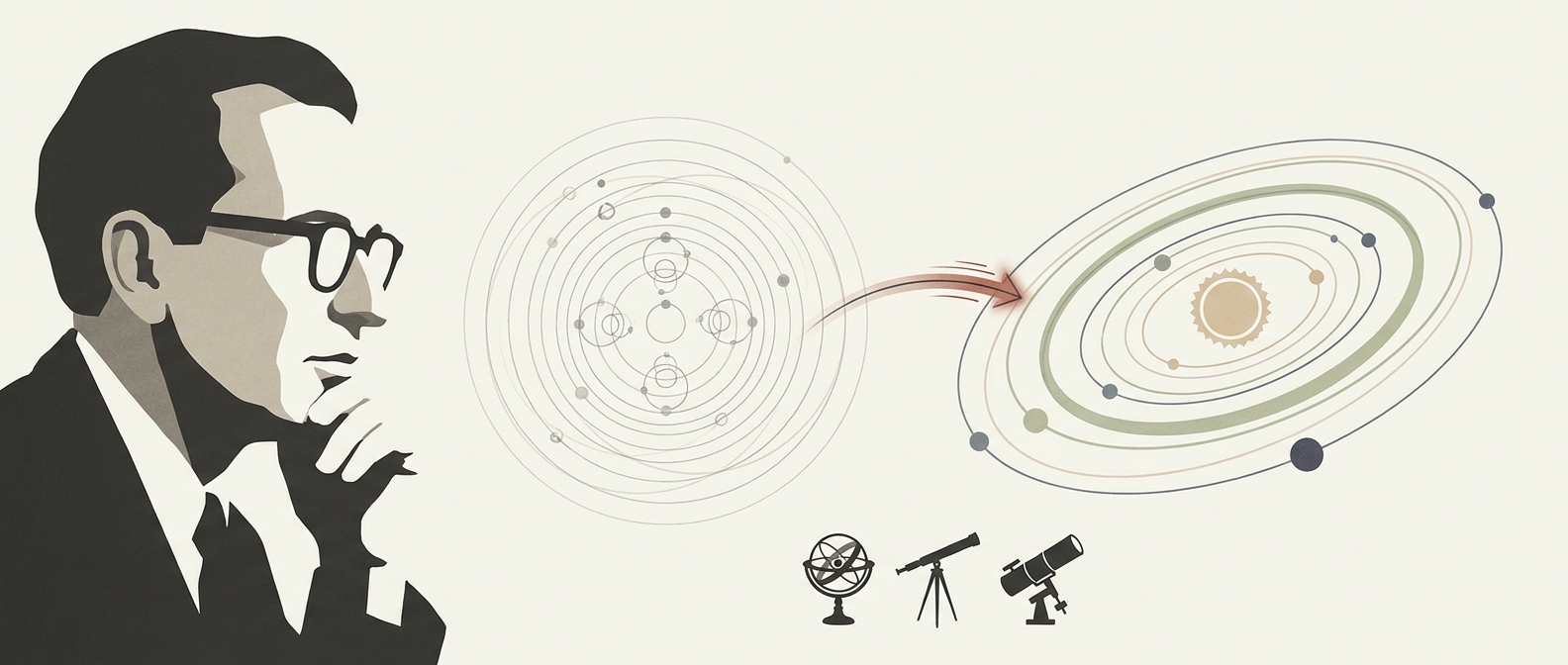
That is Kuhn’s real bar. In The Copernican Revolution, he showed that the shift from Earth-centered to Sun-centered astronomy was not the accumulation of better measurements. Ptolemy’s system could absorb almost any new measurement by adding another epicycle. The revolution came when the additions themselves became the anomaly — when the frame’s repairs grew so baroque that a rival frame’s simplicity became visible as a choice. The old frame did not fail on facts. It failed on the accumulating strain of its own patches.
The governance vocabulary is currently in its epicycle phase. Every anomaly gets a new sub-clause, a new risk tier, a new documentation requirement. The frame absorbs everything. That absorptive capacity is not evidence the frame is healthy. In Kuhn’s reading, it is exactly what a paradigm does right before the strain becomes visible. But absorption is not yet crisis. The patches still feel like progress. So the honest verdict is: this is normal science flattening its own vocabulary, not a revolution. Whoever calls it a paradigm shift is mistaking the settling of a frame for its breaking.
What Would Actually Move the Reading
A Kuhn column ends where every honest diagnosis must — on the evidence question. What would count as the settled frame breaking rather than merely being maintained? Because the whole argument above is falsifiable, and it should be held to that standard.
The frame is merely being maintained if the following continues. Governance vocabulary keeps growing more elaborate. Each new anomaly gets absorbed as a new compliance category. The two communities keep converging on shared words while diverging on meanings, and neither notices. The disappeared words — transformation, deep learning, partnership — stay disappeared, and no one experiences their absence as a loss, because the neutral register feels like maturity. Under this scenario, the ratio noted earlier keeps climbing. Governance-talk drowns capability-talk further, and the flattening is read as progress rather than as narrowing. That is a stable paradigm doing its work.
The frame is breaking if something else happens — something the current vocabulary cannot describe. Watch for these signs, in order of increasing significance.
First, watch for anomalies that resist reclassification. A system does something that