AI Literacy for Citizen Participation Report
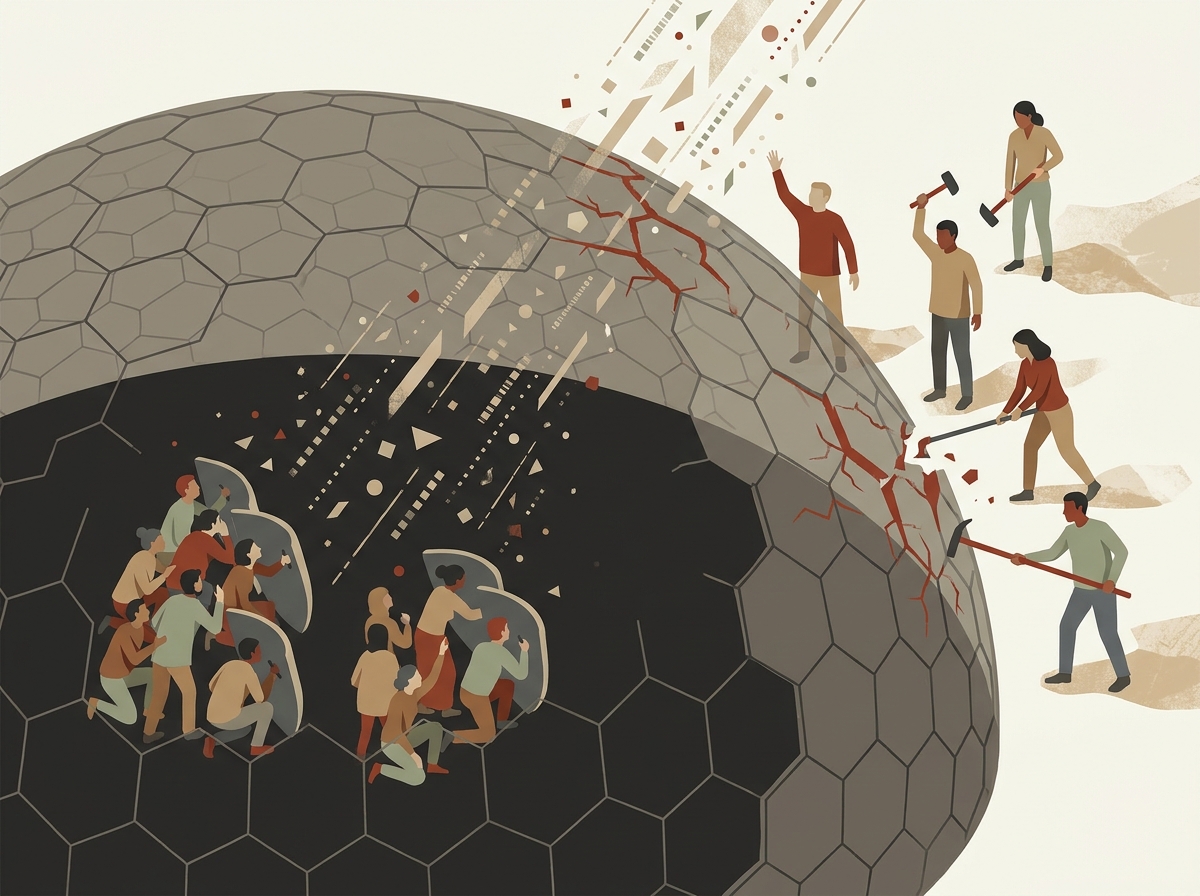
Analysis of 1,163 AI literacy sources drawn from a corpus of 5,494 reveals a discourse focused on personal defense while neglecting collective agency. The citizen-as-participant framing — the reader as someone who might shape how AI is governed, not merely survive it — appears in fewer than one in five sources. Most treat literacy as a form of threat-avoidance: learn the tells of a scam, spot the deepfake, guard your data. Watch this move, because it is the whole game. The question quietly shifts from what should AI be allowed to do to us to how good are you at noticing when it does.
The Landscape
“AI literacy,” as the current discourse uses the term, has drifted from competence toward vigilance. The dominant register is protective. A Spanish bank is ordered to compensate a customer 6,000 euros after fraudsters impersonated its own employees Una estafa protagonizada por falsos empleados del BBVA; a fake bank adviser uses a deepfake to extract 120,000 euros in the Île-de-France Île-de-France : un faux conseiller bancaire; voice-cloning fraud is tallied at $893 million AI Voice Cloning Scam Statistics 2026. Notice who defines literacy in these stories: banks, platforms, and law enforcement, each of whom has an interest in a public trained to be careful rather than a public empowered to demand different systems. The corpus’s own weighting confirms the tilt — “stakes and position” is the single largest analytical dimension, outrunning both “concepts” and “purpose.” The discourse knows what’s at risk. It is far less clear about what citizens are supposed to do.
Whose Literacy
The teaching flows one direction. Expert institutions — Stanford’s HAI testifying on chatbot data privacy PDF Safeguarding Data Privacy and Well-Being for AI Chatbot Users, the Brennan Center weighing election disinformation Does AI Fight or Fuel Election Disinformation?, the founder of PISA warning that AI is eroding young people’s core skills Le fondateur de PISA alerte — speak about citizens far more often than citizens speak for themselves. Even Anthropic’s disclosure that it disrupted a pro–Awami League fake-news operation Anthropic says it disrupted pro-Awami League AI fake-news operation is a vendor narrating its own guardianship. The one genuine bottom-up signal is refusal: coverage of a growing anti-AI resistance La resistencia contra la IA gana fuerza is the closest the corpus comes to ordinary people setting the terms rather than absorbing them.
What’s Being Taught
The syllabus, read across clusters, is heavy on detection and light on judgment. Citizens are urged to identify manipulated images Ces images sont-elles vraies ou fausses?, to distrust chatbots that fail basic news accuracy AI chatbots fail at accurate news, and to notice that health “AI slop” reaches 81 million followers through hundreds of fake medical accounts From Doctors to Healers. Useful, all of it. But detection is a treadmill: the manipulation of Google’s own AI results Google’s AI is being manipulated shows the ground shifting faster than any individual can track. Teaching people to spot fakes while the fakes improve exponentially is teaching them to lose slowly.
What’s Missing
Almost entirely absent: the citizen as governance participant. When California’s kid-safety laws arrive backed by Sam Altman Newsom signs online kid safety laws, the public is a beneficiary, not an author. Missing too are the competencies of collective action — how to read a regulation, contest a platform’s design, or demand accountability when Meta fails to catch AI child-abuse ads until a city government intervenes San Francisco Orders Meta to Stop ‘Allowing’ AI Child Abuse Ads. The literacy the discourse withholds is the political kind.
Core Tensions
The phrase “AI literacy” behaves like a consensus term—everyone nods—precisely because it papers over a fight about what citizens are supposed to know and, more pointedly, who benefits from them knowing it. Across the 5494 sources we reviewed this week, no clean contradiction map emerged; what surfaced instead was something harder to file: a set of load-bearing tensions that no curriculum, no public-awareness campaign, and no vendor “responsible AI” pledge resolves. This isn’t a knowledge gap to fill. It’s contested terrain, and the contest is about power.
Protection from versus empowerment with. The week’s most concrete evidence is a litany of harm done to people, not by them. A BBVA customer was reimbursed €6,000 after fraudsters impersonating bank staff worked the con Una estafa protagonizada por falsos empleados del BBVA obliga al banco a indemnizar a un cliente con 6.000 euros; an Île-de-France victim lost €120,000 to a deepfaked “bank adviser” Île-de-France : un faux conseiller bancaire utilise un deepfake et lui …; voice-cloning fraud is now measured in the hundreds of millions AI Voice Cloning Scam Statistics 2026: $893M in AI Fraud Data. The “empowerment” story—learn the tools, gain agency—sits uneasily beside evidence that the most consequential AI literacy a citizen needs right now is defensive: how to distrust a voice that sounds exactly like your daughter. Notice who wins if literacy is framed as personal vigilance: the banks and platforms whose systems generated the exposure get to treat your credulity as the failure point.
Individual competency versus collective governance. The defensive framing quietly transfers responsibility onto individuals. But the harms are structural. Meta failed to catch hundreds of AI-generated child-abuse ads, some using images of real children Meta Failed to Catch Hundreds of AI Child Abuse Ads. …, prompting San Francisco to order the company to stop San Francisco Orders Meta to Stop ‘Allowing’ AI Child Abuse Ads. No amount of citizen “literacy” audits a recommendation engine. When California’s Newsom signed child-safety rules—some backed by Sam Altman Newsom signs online kid safety laws, including rules backed by Sam Altman—the tell was the endorsement: vendors prefer rules they help write. Literacy that stops at the individual leaves governance to the governed-over.
Consumer literacy versus citizen literacy. These are not the same skill. Knowing an ad might be synthetic protects your wallet; knowing an election might be manipulated protects the polity—and requires evaluating institutions, not just outputs. Anthropic disrupted a pro–Awami League fake-news operation running on its own model Anthropic says it disrupted pro-Awami League AI fake-news operation; Brazil’s pre-election period saw AI deployed five distinct ways A un mes de las elecciones en Brasil, la IA es usada de 5 formas …; a European election was annulled amid AI-amplified destabilization L’IA et la démocratie Campagnes déstabilisées, élection annulée. Yet Knight Columbia’s audit of 78 election deepfakes cautions that the crisis is often over-attributed to AI—cheap fakes and old-fashioned lies still do most of the work We Looked at 78 Election Deepfakes. Political Misinformation Is Not an …. Citizen literacy includes knowing when “it’s the AI” is itself the manipulation.
Use versus refusal. Literacy discourse assumes adoption. But resistance is now a literate position too La resistencia contra la IA gana fuerza, sharpened by evidence that chatbots deliver less-accurate information and can strengthen false beliefs AI chatbots fail at accurate news, major study reveals - dw.com, and that the PISA founder warns heavy reliance is eroding young people’s core skills Le fondateur de PISA alerte: Les jeunes perdent des compétences clés, l’IA sape leurs capacités.
The metaphor doing the work. In our corpus AI reads overwhelmingly as Tool (304 instances) and only occasionally as Threat (52). A tool implies a competent user and neutral instrument—which is exactly why vendors love it, and exactly what the fraud and propaganda evidence contradicts. Partner appears just 7 times, and it would demand something the Tool frame never asks: that the thing has interests, and that citizens interrogate whose. The most useful literacy this week is the capacity to notice which metaphor a headline is quietly installing—and to ask what that framing lets its author off the hook for.
Power & Agency Analysis
Power in AI literacy operates through definition: whoever decides what citizens “need to know” also decides what stays invisible. And the most consequential thing kept invisible is agency itself — the question of who, exactly, is acting when “the AI” does something to you. Across this week’s coverage the dominant grammar is the tool metaphor, appearing in 304 of the framings we tracked against just 52 that cast AI as threat. That ratio is not neutral. It is a lesson being taught, and it teaches citizens to look at the wrong actor.
How AI is portrayed
Watch the sentence structure in almost any report of AI harm. A deepfake “tricked” a bank client out of €120,000 Île-de-France : un faux conseiller bancaire utilise un deepfake et lui …. AI “is used in five ways” ahead of Brazil’s elections A un mes de las elecciones en Brasil, la IA es usada de 5 formas …. Chatbots “provide” false information AI chatbots fail at accurate news, major study reveals - dw.com. The technology is the subject of the verb; the human operating it recedes into passive construction. Yet where reporting names the actor, the picture inverts. Anthropic did not describe a rogue machine — it described a coordinated human operation running fake news on behalf of the Awami League, which its systems disrupted Anthropic says it disrupted pro-Awami League AI fake-news operation. The 232 Facebook accounts pushing health “AI slop” to 81 million followers are run by people selling supplements From Doctors to Healers: 232 Facebook Accounts Publish Health ‘AI Slop’. When agency is assigned to the tool, the person profiting from the harm gets to stand behind it. Literacy begins by refusing that grammar and asking: who is holding the tool?
Who defines literacy
Notice who is writing the definitions. Sam Altman’s company helped shape the child-safety rules Governor Newsom just signed Newsom signs online kid safety laws, including rules backed by Sam Altman. Anthropic’s Dario Amodei argues we must “pace the frontier” We Must Pace the Frontier — a frame in which the vendor sets the tempo and the public keeps up. When the entities that profit from a technology also author the vocabulary for understanding it, “literacy” quietly becomes compliance: knowing how to use the product safely rather than knowing enough to refuse it, regulate it, or hold its maker liable. The absent voice here is the citizen’s own. Expert testimony on chatbot data privacy reaches legislators PDF Safeguarding Data Privacy and Well-Being for AI Chatbot Users; the person whose intimate data is at stake rarely testifies about their own life.
What metaphors teach
The tool metaphor’s lesson is that responsibility flows to the user — you should have spotted the scam, verified the image, read the terms. The threat metaphor teaches something equally distorting: that the danger is autonomous and therefore no one in particular is to blame. Both erase the operator. The corrective is already visible in the research. The Knight Institute, having examined 78 election deepfakes, concluded that political misinformation “is not an AI problem” — it is a human incentive problem that predates the technology We Looked at 78 Election Deepfakes. Political Misinformation Is Not an …. Brookings warns that the more useful move is often the false claim of a deepfake — the liar’s dividend — which only works if you believe the tool acts alone Watch out for false claims of deepfakes, and actual … - Brookings. Critical metaphor literacy means hearing “the AI decided” and mentally rewriting it to “someone deployed a system that produced this outcome, and profited.”
Citizen agency
What power does a citizen actually hold? More than the tool framing admits, less than the vendors imply. Individual vigilance failed the BBVA client — yet the bank was ordered to pay €6,000 anyway, because liability sat with the institution, not the victim Una estafa protagonizada por falsos empleados del BBVA. A court held Google liable for its AI’s false statements; San Francisco ordered Meta to stop running AI abuse ads San Francisco Orders Meta to Stop ‘Allowing’ AI Child Abuse Ads. The resistance movement gaining ground in Europe La resistencia contra la IA gana fuerza understands the lesson these cases share: agency, for citizens, is collective and it is legal. Knowledge protects you only up to the point where it converts into a demand that the actor behind the tool be named — and made to pay.
Drawn from 5,494 sources this week.
Failure Genealogy
Literacy failures differ from technical failures: they occur when citizens misunderstand what AI is, what it’s doing, or how to evaluate it. Our analysis, drawn from this week’s category of 1,163 AI-literacy articles within a 5,494-source corpus, documents five recurring ways understanding breaks down — not in the model, but in the person facing it.
Where understanding fails
The most expensive failures are failures of recognition. A retiree in Île-de-France lost €120,000 to a caller whose voice and face were synthetically cloned to impersonate a bank advisor Île-de-France : un faux conseiller bancaire utilise un deepfake; a BBVA customer was defrauded by “employees” who never existed, and a court eventually forced the bank to pay Una estafa protagonizada por falsos empleados del BBVA. Voice-cloning fraud alone accounted for some $893 million in documented losses AI Voice Cloning Scam Statistics 2026. These are detection gaps: the citizen’s prior — “if it sounds like my bank, it is my bank” — no longer holds, and nobody updated the prior.
But over-trust runs the other direction too. A major study found chatbots systematically fail at accurate news, confidently reproducing errors AI chatbots fail at accurate news, and 232 Facebook accounts posing as doctors pushed “AI slop” health misinformation to 81 million followers From Doctors to Healers. The failure isn’t that the content exists; it’s that fluency reads as authority.
What assumptions mislead
Three assumptions do the most damage. First: that the visible artifact is the threat. The Knight Columbia review of 78 election deepfakes found political misinformation is “not an AI problem” in the sense citizens fear — cheap fakes and false claims of deepfakes do comparable work We Looked at 78 Election Deepfakes, a dynamic Brookings calls the “liar’s dividend”: once anything could be fake, everything real becomes deniable Watch out for false claims of deepfakes. Second: that a chatbot is a neutral librarian. NPR documented how AI overviews launder foreign propaganda into confident summaries How AI chatbots and AI overviews parse foreign propaganda, and the search layer itself is being actively gamed Google’s AI is being manipulated. Third: that talking to a bot is private. Stanford’s testimony on chatbot data privacy shows users hand over intimate disclosures with no working model of where those words go Safeguarding Data Privacy and Well-Being for AI Chatbot Users.
Consequences of gaps
The costs are unevenly borne. MIT researchers found chatbots deliver less accurate answers to more vulnerable users — the people least equipped to catch the error Study: AI chatbots provide less-accurate information to vulnerable users. France’s CNIL flags adolescents confiding mental-health data to conversational AI Les jeunes et l’IA : confier ses données intimes n’est pas sans risque, and the PISA founder warns that outsourcing cognition to AI is eroding the very evaluative skills detection requires Le fondateur de PISA alerte. Collectively, the erosion is civic: a month before Brazil’s elections, AI was deployed across five distinct manipulation channels A un mes de las elecciones en Brasil.
What would help
The pattern suggests literacy should target provenance reflexes, not artifact-spotting — the habit of asking “who benefits from my believing this, and how would I check?” before asking “is this a deepfake?” That reframe would have caught the BBVA and Île-de-France scams, where the tell was the request, not the pixels. But honesty compels a limit: when Anthropic must disrupt influence operations at the infrastructure level Anthropic says it disrupted pro-Awami League AI fake-news operation, the message is that no individual reader can out-vigilance an industrialized system. Literacy reduces personal exposure; it does not substitute for the institutional detection citizens are being quietly left to perform alone.
Evidence Synthesis
Synthesizing this week’s 5,494 sources, the evidence on AI literacy points to an uncomfortable finding: the skill we keep prescribing is being outrun by the environment it was meant to navigate. This goes beyond technical skill. The prior consensus in these pages—that literacy programs succeed or fail on resources, infrastructure, and curriculum updates—now looks incomplete. The newer evidence shows literacy failing not because citizens lack access to training, but because the information terrain is being actively engineered against comprehension, and because the tools people reach for to understand it are themselves unreliable narrators.
What the evidence shows
Start with what converges. Multiple independent investigations this period document coordinated, industrialized deception rather than isolated fakery. Anthropic disclosed disrupting a pro–Awami League operation that used its own model to manufacture fake news Anthropic says it disrupted pro-Awami League AI fake-news operation; Maldita traced 232 Facebook accounts pushing health “AI slop” to 81 million followers From Doctors to Healers: 232 Facebook Accounts Publish Health ‘AI Slop’. The scale matters: a Senate hearing warned AI is “industrializing” fraud against older Americans Senate hearing warns AI is industrializing fraud against older Americans, with voice-cloning scams alone tallying $893 million AI Voice Cloning Scam Statistics 2026. What “works” against this, the evidence suggests, is less individual vigilance than institutional liability—a court has now held Google responsible for false statements its AI Overviews generated A Court Has Ruled That Google Is Liable for False Statements Generated by AI Overviews.
Contested terrain
Here the evidence genuinely conflicts. The apocalyptic framing—elections drowned in deepfakes—does not survive scrutiny. Knight Columbia examined 78 election deepfakes and concluded political misinformation “is not an AI problem” so much as an old problem with new production values We Looked at 78 Election Deepfakes, and Brookings warns the more corrosive move is the false claim of a deepfake—the liar’s dividend Watch out for false claims of deepfakes. Yet Canada saw an election annulled amid AI-destabilized campaigns L’IA et la démocratie. “Literacy” stays contested because the two camps are measuring different things: detection skill versus epistemic resilience.
Across domains
The tool dimension is where literacy claims quietly collapse. A major study found chatbots fail at accurate news AI chatbots fail at accurate news, and MIT reports they deliver less accurate information to vulnerable users Study: AI chatbots provide less-accurate information to vulnerable users—the people with least margin get the worst answers. This is the equity dimension made concrete. On the social side, the PISA founder warns AI is eroding the underlying cognitive capacities literacy presupposes Le fondateur de PISA alerte, while French research flags young people surrendering intimate data to conversational AI Les jeunes et l’IA : confier ses données intimes n’est pas sans risque.
Gaps and uncertainty
What we do not know is whether any curriculum can keep pace with generation speed—and whether “resilience” is even teachable at population scale, or merely correlated with prior education. The evidence is near-silent on which interventions durably change behavior versus which merely raise awareness that fades.
For citizens
Two takeaways survive the evidence. Individually: treat any AI output—chatbot, Overview, cloned voice—as an unverified claim, especially when it concerns money, health, or a vote, and slow down at exactly the moments urgency is manufactured Île-de-France : un faux conseiller bancaire. Collectively: the durable defenses this week were liability rulings and safety laws Newsom signs online kid safety laws, not literacy pamphlets. Personal skill is necessary; it was never going to be sufficient.
References
- A Court Has Ruled That Google Is Liable for False Statements Generated by AI Overviews
- A un mes de las elecciones en Brasil, la IA es usada de 5 formas …
- AI chatbots fail at accurate news
- AI Voice Cloning Scam Statistics 2026
- Anthropic says it disrupted pro-Awami League AI fake-news operation
- Ces images sont-elles vraies ou fausses?
- Does AI Fight or Fuel Election Disinformation?
- From Doctors to Healers
- Google’s AI is being manipulated
- How AI chatbots and AI overviews parse foreign propaganda
- L’IA et la démocratie Campagnes déstabilisées, élection annulée
- La resistencia contra la IA gana fuerza
- Le fondateur de PISA alerte
- Les jeunes et l’IA : confier ses données intimes n’est pas sans risque
- Meta Failed to Catch Hundreds of AI Child Abuse Ads. …
- Newsom signs online kid safety laws
- PDF Safeguarding Data Privacy and Well-Being for AI Chatbot Users
- San Francisco Orders Meta to Stop ‘Allowing’ AI Child Abuse Ads
- Senate hearing warns AI is industrializing fraud against older Americans
- Study: AI chatbots provide less-accurate information to vulnerable users
- Una estafa protagonizada por falsos empleados del BBVA
- Watch out for false claims of deepfakes, and actual … - Brookings
- We Looked at 78 Election Deepfakes. Political Misinformation Is Not an …
- We Must Pace the Frontier
- Île-de-France : un faux conseiller bancaire