Student Perspective Brief
Executive Summary
You represent a sliver of the conversation shaping how AI is used in your education. This briefing synthesizes 4,004 sources from this week to give you what institutional policy meetings aren’t: the actual evidence, the real tradeoffs, and the agency you still have. The largest study of undergraduate AI use to date found the divide isn’t simply cheaters versus honest students—it’s The largest study of AI use by undergrads is in, revealing disparities …, with paid tools and confident usage clustering among students who already had advantages.
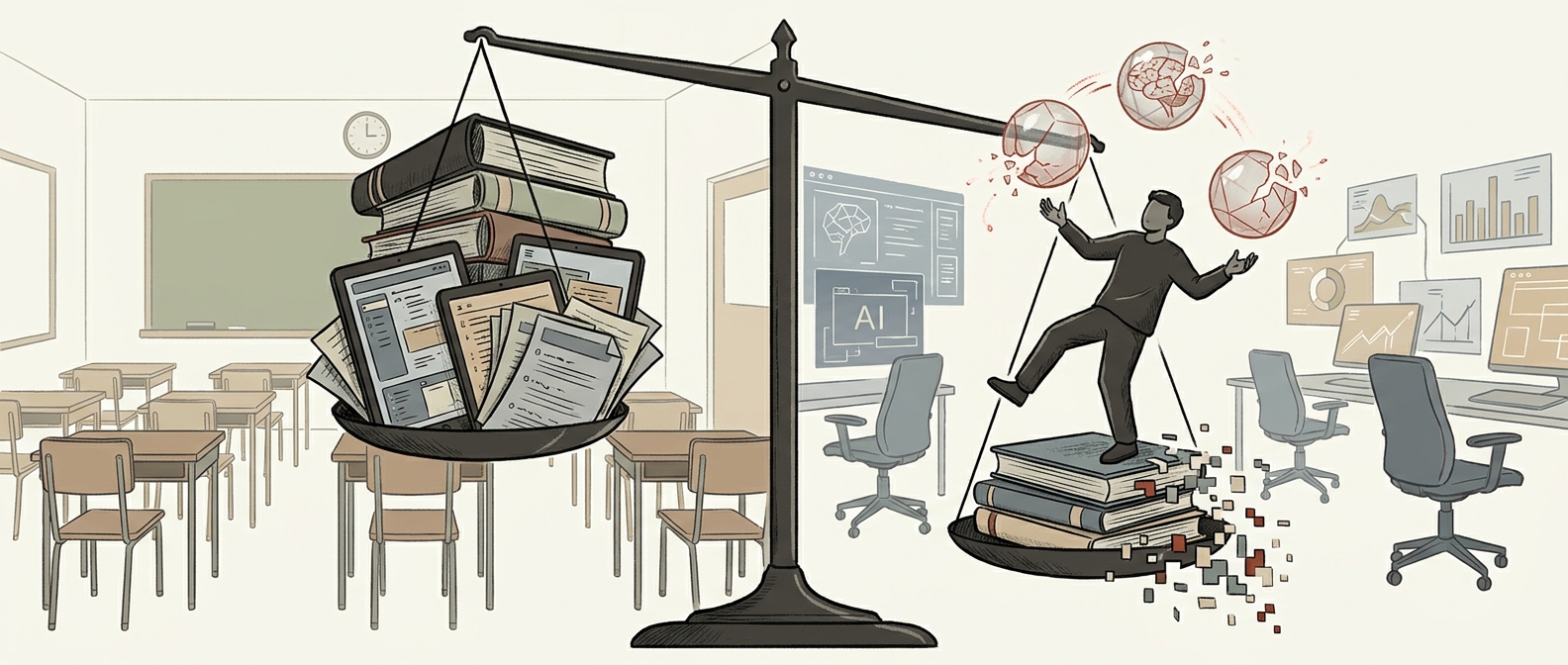
Here’s the core tension nobody is stating plainly to you. Over-rely on AI and you offload the exact cognitive work a degree is supposed to build—researchers documenting how students offload critical thinking and other hard work to AI are describing a skill you’re paying tuition to acquire and quietly not acquiring. Avoid it entirely and you graduate into a workforce that assumes fluency. Neither extreme is a safe default, and no syllabus is going to resolve that for you.
Meanwhile, the enforcement side is genuinely unreliable. Detection scores are being treated as verdicts despite weak evidentiary standing—see the AI-detection due-process ladder and the Newby v. Adelphi ruling, the first court test of a detection-based accusation. If you’re flagged, opaque software output is not proof, and AI Detection Tools and Academic Punishment: How Opaque Evidence …. Know that before you’re in the room.
Expect the ground to keep shifting: institutions are moving toward in-person tests and oral exams, which reward understanding over polished output.
This briefing provides evidence-based strategies for using AI to deepen learning rather than replace it, clear signals for when to keep it closed, and practical guidance for navigating detection policies that are being applied faster than they can be justified.
Critical Tension
The Real Dilemma
Here is the tension nobody hands you in a syllabus: the same tool that can genuinely accelerate your learning is the one your institution is increasingly building machinery to catch you using. The largest study of undergraduate AI use to date found real disparities not just in who cheats but in who has access to these tools in the first place The largest study of AI use by undergrads is in, revealing disparities …. Meanwhile, 90% of faculty in one survey report that AI is weakening student learning 90% Of Faculty Say AI Is Weakening Student Learning: How … - Forbes. So you are operating inside a system that simultaneously assumes you’re using AI, suspects you’re using it wrongly, and hasn’t decided what “right” looks like.
For your actual learning, this means the risk isn’t only pedagogical — it’s procedural. Detection software can flag your original work as machine-generated, and the documented false-positive problem is not rare Faux positifs détecteurs IA : causes, impacts et solutions. When that happens, an opaque score can function as a verdict before you’ve said a word AI Detection Tools and Academic Punishment: How Opaque Evidence …. You are being asked to make good-faith decisions about a technology whose evidentiary treatment is still being fought over in court AI Cheating Lawsuits Tracker — Every Case, Who Won (2026).
Why Institutional Guidance Isn’t Helping
The inconsistency is real and it isn’t your fault. One professor bans laptops from the classroom entirely UChicago Law Bans Laptops from 1L Classrooms As Part of Sweeping New AI …; another builds a custom tutor bot and reports engagement doubling Professor tailored AI tutor to physics course. Engagement doubled.. Some programs now mandate AI learning Mandatory College-directed AI learning for 2026-27 while others treat any use as misconduct. The rules can flip between two courses you take in the same semester, and the burden of tracking that lands on you.
Notice who is missing from the table. Across this week’s coverage, the student voice registers at roughly 3.76% of the conversation. Decisions about detection thresholds, appeals procedures, and what counts as legitimate assistance are being made largely without the people who bear the consequences. When your institution adopts a proctoring or detection vendor, it is outsourcing a pedagogical judgment to a product — and the ethical case against that outsourcing is being made by faculty, not students Remote Proctoring Through an Ethical Lens: The Case Against ….
The Skills Question
The honest worry about offloading is not moral, it’s cognitive. When AI handles the hard middle of a task — structuring an argument, working through a proof, sitting with a difficult reading — you can lose the very friction that builds the skill University students offload critical thinking, other hard work to AI. There’s also a quieter loss: AI can erode the social core of group work, letting you skip the negotiation and disagreement that teamwork was supposed to teach Is AI quietly eroding the social core of student teamwork? - HEPI.
But “future readiness” now also requires skills nobody is systematically teaching you: how to direct a model, verify its output, and know when its fluent answer is confidently wrong. That’s why assessment itself is shifting — toward oral exams and in-person work designed to test what you actually understand Colleges are turning to in-person tests, oral exams to combat AI | AP News. The reframing worth watching is the move to redesign assignments around AI rather than police it AI in class: time to rethink assignments. The skill being valued is judgment, not output.
Your Position
Your agency is narrower than the marketing suggests and wider than the rules imply. You cannot control which detector your instructor runs or how they read its score — so document your process: drafts, version history, notes. That’s your defense if an opaque tool flags you Score-as-Verdict: The AI-Detection Due-Process Ladder. Where you do have control is the decision about which cognitive work you hand off. Using AI to check your logic is different from using it to skip the thinking; only one of those still leaves you able to defend the work in an oral exam. Ask each instructor, in writing, what’s permitted — the inconsistency is theirs to resolve, but the paper trail protects you. Navigate this as someone building a skill, not managing a suspicion.
Actionable Recommendations
For Students Developing Their Own AI Practices
You are the one navigating a system that has not decided what it wants from you. Faculty are split — 90% Of Faculty Say AI Is Weakening Student Learning: How … - Forbes — even as some of the same institutions build custom tutor bots and reward fluency. That inconsistency is not your fault, but managing it is your problem. Here are five moves you can make yourself, this week, without waiting for a policy to stabilize.
Audit your own offloading before someone audits you
The common approach is to use AI reactively — you hit friction on a task, you paste it into a chatbot, you move on. This backfires because the friction you’re skipping is frequently the learning itself. Students in recent work are documented offloading critical thinking and other hard work to AI, and the cost is invisible until an exam or interview asks you to do the thing unaided.
A more effective approach: track what you hand off, not just whether you use AI.
- This week: keep a running note of every AI interaction and tag it “did the thinking for me” or “helped me think.” Be honest.
- This month: look at the ratio. If the first tag dominates in your major courses, you’re building a dependency in exactly the skills you’re paying to develop.
- This semester: deliberately do the hard first draft — the outline, the proof, the argument structure — unaided, then bring AI in to pressure-test it.
What this builds: metacognitive awareness of your own competence, the thing no detector can measure and no employer can fake-check.
What to watch for: the moment you can’t reconstruct why an answer is right, only that the AI produced it.
Protect the skills that get tested in a room with no wi-fi
The assumption that AI-assisted work is the finish line is already outdated. Institutions are moving assessment back into rooms you can’t automate — colleges are turning to in-person tests and oral exams to combat AI, and law schools are going further, with UChicago Law banning laptops from 1L classrooms. The Oral Exams & AI: A Practical Alternative to Take-Home Writing is that they surface what you actually understand.
A more effective approach: treat every AI-assisted assignment as rehearsal for an unassisted defense of it.
- This week: after finishing any AI-supported work, close the laptop and explain the argument out loud, from memory, to a friend or the wall.
- This month: form a study pair and quiz each other on reasoning, not recall.
- This semester: seek out the courses and formats that test you live. They’re annoying, and they’re where your transcript becomes credible.
What this builds: the ability to perform under the conditions your field is re-adopting.
What to watch for: relief when a class is “all take-home.” That relief is a signal you’re avoiding the skill, not mastering the format.
Navigate inconsistent policies in writing, not on trust
Here’s the move to watch: institutions are outsourcing the judgment of whether you cheated to detection software that doesn’t hold up. Detectors produce false positives with documented causes and impacts, and the legal record is filling — the AI Cheating Lawsuits Tracker and the first AI-detection court ruling in Newby v. Adelphi show what happens when a Adelphi University accused a student of using AI to … - Newsday. Legal scholarship warns that AI Detection Tools and Academic Punishment: How Opaque Evidence … — the “score-as-verdict” problem where a number becomes an accusation with Score-as-Verdict: The AI-Detection Due-Process Ladder.
You can’t fix that system. You can refuse to be its easiest target.
- This week: for each course, find the exact AI clause in the syllabus. Where it’s vague, email the instructor and get the answer in writing. Rules differ course to course — the tension between a duty to understand AI and a right to refuse it is unresolved, and you need each instructor’s version on record.
- This month: keep your drafts, version history, and notes. Process documentation is the evidence a detector score can’t manufacture.
- This semester: if AI use is permitted, disclose it the way that course asks — the disclosure protects you more than it exposes you.
What this builds: a paper trail and the habit of getting ambiguous authority to commit.
What to watch for: an instructor who won’t put the policy in writing. That’s the one whose class needs your documentation most.
Evaluate the output like an editor, not a customer
The efficiency is real — that’s not in dispute. Tools like academic research skills for Claude Code and custom AI tutor bots at Harvard Business School do accelerate real work, and a physics tutor tailored to the course doubled engagement. The failure mode isn’t using them — it’s trusting them.
A more effective approach: assume the output is a confident first draft by a stranger who doesn’t know your field.
- This week: for one AI answer, verify every factual claim and every citation against a primary source. Note how many don’t survive.
- This month: use AI to generate counterarguments to your own position, then judge them yourself.
- This semester: build a personal reliability map — where the tool is strong in your discipline and where it fabricates.
What this builds: the critical-evaluation skill that separates someone who uses AI from someone AI uses.
What to watch for: fluent prose you didn’t check. Fluency is the tool’s best disguise.
Position for what actually gets rewarded next
The signal from access research should reframe your strategy: the largest study of undergraduate AI use documents disparities in access and in cheating. Mandatory AI competency is arriving in professional credentialing — see mandatory college-directed AI learning for 2026-27. Employers and grad programs are converging on judgment, not keystrokes.
- This week: identify one collaborative project and do the human part deliberately — AI is quietly eroding the social core of student teamwork, and negotiation, disagreement, and division of labor are the parts interviews probe.
- This month: as AI in class: time to rethink assignments, keep artifacts that show your reasoning, not just your outputs.
- This semester: build a portfolio that documents how you decide — the durable credential when the doing is commoditized.
What this builds: demonstrable judgment.
What to watch for: a resume of things AI could have produced. That’s the profile the next hiring filter is built to discount.
Supporting Evidence
The Detection Machine Is On Trial—And So Are You
What We Analyzed
This week we synthesized 4,004 sources across the AI-and-education landscape, with 1,359 falling squarely in the higher-education category. This is not the complete picture of what’s happening to your degree—it’s a snapshot of the current discourse, the arguments institutions, vendors, and faculty are having about you, often without you in the room. Read it as a map of the debate, not the territory of your actual education.
Who’s Speaking, Who’s Not
Here’s the first thing worth naming: the discourse is dominated by faculty concern and institutional risk-management, not by the people whose transcripts and disciplinary records are on the line. When 90% of faculty say AI is weakening student learning, that framing sets the agenda—the problem is defined as your deficit before anyone asks what the tools are actually doing.
The largest empirical study of undergraduate AI use tells a different story than the panic. Berkeley’s data shows The largest study of AI use by undergrads is in, revealing disparities …—meaning the students most likely to be flagged are not evenly distributed. When the dominant voice is institutional liability rather than the student experience, the questions that get funded are “how do we catch them” rather than “what did access inequality build into the baseline.” Feminist and Global South analysts have flagged exactly this centering problem in Feminist and Global South perspectives on AI-supported …: whose competence counts as the default gets decided upstream of any individual case.
What’s Actually Being Debated
The unresolved fight this week is whether an AI-detection score can function as evidence of misconduct. It cannot reliably, and the courts are now saying so. Newby v. Adelphi produced the first AI-detection court ruling—a student accused of using AI who Adelphi University accused a student of using AI to … - Newsday. The broader AI Cheating Lawsuits Tracker shows this is not one angry student—it’s a pattern. Adults are figuring this out in real time. You are navigating without a map because no one has drawn one yet.
Where Implementations Are Failing
The failures cluster around due process and false positives—the ethical and procedural core, not edge cases. Detection tools generate false positives with documented causes and impacts, and legal scholars argue that AI Detection Tools and Academic Punishment: How Opaque Evidence … when a proprietary score becomes a verdict. That mechanism has a name now: the score-as-verdict due-process ladder, where a probability output gets laundered into a finding of guilt. Meanwhile universities keep relying on detection software whose own vendors won’t stand behind it as forensic proof. What’s prioritized: institutional speed. What’s neglected: your right to contest the machine.
What This Means for You
The evidence on skill development is genuinely mixed, and you should hold that honestly. There is real signal that students offload critical thinking and hard cognitive work to AI—that risk is not manufactured. But the same period produced evidence that a tailored AI tutor doubled engagement in a physics course and that custom tutor bots are reshaping learning at HBS. The tool that erodes your thinking and the tool that deepens it can be the same tool used differently. No one has cleanly separated the two conditions.
So expect the ground to keep moving. Institutions are already reaching for the low-tech response: colleges are turning to in-person tests and oral exams as a practical alternative to take-home writing, and UChicago Law has gone as far as banning laptops from 1L classrooms. A quieter cost is barely being measured: HEPI asks whether AI is eroding the social core of student teamwork—the collaboration that a degree is partly supposed to teach.
The honest bottom line: the research does not yet know whether AI helps or hurts your learning, but the legal record is increasingly clear that a detection score is not proof you did anything wrong. Keep your drafts, your version history, your process. In a system running ahead of its own evidence, documentation is the leverage you actually hold.
References
- 90% Of Faculty Say AI Is Weakening Student Learning: How … - Forbes
- academic research skills for Claude Code
- AI Cheating Lawsuits Tracker — Every Case, Who Won (2026)
- AI in class: time to rethink assignments
- AI-detection due-process ladder
- Feminist and Global South perspectives on AI-supported …
- Oral Exams & AI: A Practical Alternative to Take-Home Writing
- custom AI tutor bots at Harvard Business School
- The largest study of AI use by undergrads is in, revealing disparities …
- duty to understand AI and a right to refuse it
- Faux positifs détecteurs IA : causes, impacts et solutions
- in-person tests and oral exams
- Is AI quietly eroding the social core of student teamwork? - HEPI
- Mandatory College-directed AI learning for 2026-27
- Newby v. Adelphi ruling
- offload critical thinking and other hard work to AI
- AI Detection Tools and Academic Punishment: How Opaque Evidence …
- Professor tailored AI tutor to physics course. Engagement doubled.
- Remote Proctoring Through an Ethical Lens: The Case Against …
- Adelphi University accused a student of using AI to … - Newsday
- UChicago Law Bans Laptops from 1L Classrooms As Part of Sweeping New AI …
- universities keep relying on detection software